Sunday, March 23, 2008

The Trusty Tackle Box

No fisherman will ever go fishing without their trusty tackle box just as no medic will be without their medical-kit and no camera-man will be without their camera bag

The tackle box will be where the fisherman keeps his fishing gear and accessories, A tackle box looks like the tool-box that a handyman will carry and it is similar in that a tackle box has various sized compartments to fit various types and sizes of fishing gear.

So what do you need to put in your tackle box? Hooks are one of the most important items. You will need hooks of various shapes and sizes, even if you only plan to fish at one place. Lures are another important fishing gear and since you may not always use live bait, so keeping a few good lures are essential for any fishing trip,

Sinkers are also essential. Without the sinker, your hook will float on top of the water and be moved about by the wind or current. Sinkers are made of lead and are clamped around the line with a pair of pliers, so you'll need a pair of pliers too, unless you have strong teeth. You'll need an extra large supply of sinkers, as they are often lost when the line breaks. Of course to counteract the weight of the sinker you'll need a float. This will allow the sinker to go so far down, but no further. It's bobbing action will enable you to see when a fish is pinching at your bait and when it disappears completely, you'll know to start hauling the line in.

Also, do not forget the swivel. This important piece of gear will stop your line from getting tangled and snapping when your fish tries to outmaneuver you. It is tied between the hook and the sinker. One exception to this rule is if you are bottom fishing. Reversing the order will allow you to feel the tug of the fish on the line instead of the weight of the sinker.

Spray-on attractant and hook removers are two other must-haves, while no good angler can go without a knife. Special fishing knives have one side suited to scaling the fish while the other side is for gutting it.

On top of fishing gear, you may also want to keep a few non-fishing items in your tackle box. An insect repellent, sun-tan lotion and even lip-balm for those long hours in the sun will certainly help. To avoid smell from this items spilling over in the tackle box, remember to keep these items in a zip-lock bag.

Pix credit: http://www.shoppingwarehouse.net

Saturday, March 15, 2008

Tips for that first fishing cast

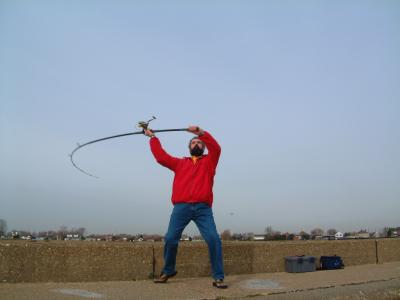
Every veteran fisherman will have a tale or two about the beginner fisherman. Many live in fear of the beginner fisherman throwing his first cast and will avoid them as much as possible to prevent getting 'into the hook's way'. To make yourself popular at the fishing site, it's a wise move to do some casting practice on the yard or roof-top before you go.

When practising, you don't need to use lures or live bait but to keep the weight true to what you will be using by tying some small pieces of thin cord or shoelace. The main principle to remember is that the fly will follow the direction that the tip of your rod was going when it was suddenly snapped during a cast.

Good casting is like a good golf swing. You need to use your whole body. So if your cast goes awry, you may find you've inadvertently lowered your hand or your shoulders as you cast. It's important to keep in sync with your body's rotation so that you can lead with your elbow for the forward move.

Another reason a bad cast is that you could be holding the rod hand too low. Watch the position of your feet as well. If your back foot is too far out and back, it will prevent you from making that abrupt stop so necessary for a long back cast.

If you find during your practice that there isn’t enough power to maintain the correct trajectory, it could be that you've cast too hard on the forward movement. This will cause slack in the line due to the fly pulling it down too hard. To correct this, accelerate faster on the back cast.

If you are a complete novice, it could be a wise move to get some training from an expert. Or you could download a video on the matter from the Internet, where you'll find many examples of a good cast from many veteran fishermen. At the very least, you'll need to observed season fishermen on site before taking your first cast.

Many fishing guides and trips also include training in their package, so it might be worthwhile to go on one of these to get expert tuition right from the start. It will stand you in good stead for the rest of your life.

Pix credit: http://wayneandwax.com

Wednesday, March 12, 2008

What fish should beginners' go for?

Every veteran fisherman will tell you about the big one that got away. Every beginner fisherman will be happy just to land their first catch!

So, what fish should the beginner fisherman go for to land the easiest first catch?

Well, the beginner fisherman will want to go after a fish that is likely to bite easily and not be too hard to reel in. He will want a fish that is not too fussy about the bait and not shy about coming forward for a feed. The kind of fish that are not easily scared off by unusual movement either. So what kind of fish fits these numerous criteria?

Some people believe that stripers are the easiest fish to catch. You can often tell where they are because they chase their favorite food, swim to the surface and attract birds and gulls along the way. All you need is to look for where the gulls and grebes are hanging over the water and that's where your stripers will be.

Stripers feeding will occur mostly near the middle of the day when sunshine is highest. This will stimulate the stripers to bite all the more.

Other fishing veterans will tell you that the easiest fish to catch are lake trout and salmon. Lake trout prefer a cool environment so you need to fish at dawn and dusk when they are most active.

Rainbow trout are most active in the summer months but still bite best at dusk as their favorite food, mosquitoes, come out to play. They can be caught at most times of the year if you understand what they like to do during those times. If you are ice fishing for trout, start just under the ice and if you don't catch anything, go deeper gradually until you get a bite.

Breams are also an ideal fish for the beginner to catch. They can be found over a wide area and are not too fussy about what they eat, so you are likely to catch them on anything from earthworms to special bass bait. Bream can be caught from either the bank or a boat even when using the most basic of fishing gear.

Pix credit: ttp://www.waterwaysireland.org

Tuesday, March 11, 2008

Fishing 101 - What kind of baits?

Other than the fishing rod, one of the main consideration of a fisherman is getting the right bait.

What is considered the right bait will depend on the kind of fish you are after. There are two main considerations for baits - live or artificial.

Many anglers prefer to use live bait, but the downside is its cost and the time it takes to re-bait your hook when you lose it - time that could be better spent in the actual fishing. Another problem could be in keeping bait alive while you are fishing.

Having spent money on live bait, you don't want to see it dead before your fishing trip is over. If you are on a boat there may be a live well to keep the bait in, or some other special container that will move and aerate the water, thus keeping the bait alive until you need it.

A popular live bait is long strips of squids for fishes such as trouts. Squids should be cut into strips of about 2 inches long and half an inch wide. You should dangles it off your hooks - that is, hook one end so you have a long, dangly piece to float around in the water to simulate a live bait.

Another popular live bait that some fishermen swear by is live prawn or shrimp. Other will use minnows and they can be real or artificial ones.

For freshwater mullet, worms can be dug out of the garden for bait. The advantage of this is that they are free and if you don't use them all, they can go back in the garden for next time.

Perch will often take crickets or white curly grubs found under logs by the riverbank. Worms and crickets can be kept for a day in a bait bucket or a bait cup that can be attached to your belt for ease of use. If using a bucket, keep it in a shady spot with some moist earth in it to keep the worms happy.

The good thing about using artificial bait is that it isn’t as likely to be lost, so that your initial outlay to buy it will be repaid over and over as you catch many fish on the same one. Of course, occasionally there may be a loss, but this will happen no matter what bait you use.

A good fishing tip you can pick up is that you should always check out the regular fishermen in the area that you intend to fish and see what bait they are using!

Pix credit: http://www.mainebait.com

Monday, March 10, 2008

Do You Need A License To Fish?

Note: This article refers to the USA only. Fishing permits differ from country to country.

A license is necessary to fish in both saltwater and freshwater. It is illegal to fish or hunt without one and the fishing license must be carried at all times, along with your personal identification.

The requirement and prices for fishing licenses vary from state to state, so you'll need to check with the State Council if you need to fish across another state. In some states, anyone under the age of 13 and over 65 doesn't need a license, while in others the minimum age is 17. In some cases, you still need to have a license but you don't need to pay a fee for one.

Nowadays, you can apply for a fishing license by mail by filling in the necessary personal particulars. You can also download online and print out the application for a fishing license and send in the application form together with the relevant fee in a cheque.

The prices for most fishing licenses are quite reasonable, usually well under $20.00, and the replacement fee after the initial cost is even lower. A license for one state won't cover you in another state.

If you go out on a charter fishing boat, you won't need a fishing license as the owner of the charter service must purchase the necessary license to run his business and that cover the permit that allows his passengers to fish. However, if you are thinking of starting up a charter service, you must also hold a Commercial fishing Guide License before you will be able to purchase the individual licenses necessary for your passengers.

Fishing licenses may be purchased for one day only, one week only, one season or a whole year at various applicable fees. You will need to check the fees as it differ from state to state.

Crabbing licenses are also required if you intend to go crabbing. If you already have a fishing license, you will still need a crabbing license, but the cost will be minimal. You need to use the specified gear to go crabbing. In some cases, a fishing license will need to be stamped to allow you to fish for trout.

Pix credit: http://www.brassdragon.biz

Saturday, March 8, 2008

What to Wear For Your Fishing Trip?

Alright, you are ready to take up fishing as a sport. What next?

Well, how about dressing up? Without the right dress, you're surely not going to look the part of a fisherman; much less a successful one.

How you dress for your fishing trip depends largely on where you are going and what the climate is like there. If you are just going to go down to the your nearest local pier and drop in a line, all you need is your hat and sunglasses. Oh, and some sunscreen if it's hot enough that you need to wear short sleeves. Remember skin safety and it's not just for sunny weather; you can still get sun burnt on a cloudy day.

Sunglasses will cut down the glare to your eyes and help you to see through the water down to where the fish are. A hat or a cap with a good brim will help to shade your eyes as well as your face. If you are fishing from the beach, the heat reflected off the sand can still burn your face even though you have a hat on, hence the need for sunscreen.

A light rainproof jacket would also be a good thing to take with you, especially if you intend to fish from a boat or from rocks. Sea spray can be mighty cold on a cool day and you never know when a sudden rain shower might hit. If you are out in a dinghy, there will be no shelter to run to.

Fishing from a boat also comes with more risk due to sudden rough conditions that may well spring up before the fishing trip is over. If you are adequately clothed, you won't have to cut your trip short due to weather conditions, unless of course, it becomes dangerous. If you are caught out in rough conditions and the boat overturns, a lifejacket could save your life. In fact in some areas lifejackets may be compulsory, so make sure there is one for each person in the boat.

On ther other hand, ice fishing will require the warmest clothes you can get, and you may need to buy them to make sure of getting the right ones. Boots are particularly important to prevent frostbite. If in a boat, you'll need footwear with good traction on the soles to prevent slipping, while waterproof boots are necessary if you intend to wade into shallow water.

Pix Credit: http://shop.lifejackets.co.uk

Basic Fishing Gear

Before you can start fishing, you need to equip yourself with some basic fishing gear. Here's our basic list of fishing gears:

1. Basic weather protection such as hat, sunglasses and sunscreen
2. A good rod and reel
3. Appropriate bait
4. Camping gear if you are staying overnight.

Basically, what you take with you when you go fishing depends on where you plan to go. Hat, sunglasses and sunscreen are often considered to be essential basic gear, but if you plan on a fishing trip into the wilds, you'll find a compass, cell-phone and flashlight handy, too.

Of course you'll need food, water and camping equipment if you plan to stay out overnight or longer. If you plan to use a hand-line for fishing, you'll need a pair of soft leather gloves to prevent line burn. Cut the fingers out at about the second joint so you can attend to other matters without taking them off.

One of the main pieces of fishing gear is a good rod or pole. These will vary depending on the type of fishing you intend to do. They can be made of cane or carbon fibers and should be flexible, while still being strong enough to handle the weight of a large fish. Some can be taken apart for ease of carrying in a vehicle, in which case, it will have a cloth bag for carrying.

Whether you carry it in this and assemble it on the job, or assemble it at home and then stick it out the car window to travel is up to you. Many off road vehicles have fishing pole holders attached to the front end.

When choosing a rod, make sure the eyelets that hold the line are smooth with no abrasive feel to them. Roughness here can cause your line to snap at the vital point of landing that big one.

The reel is also a vital piece of equipment. For freshwater fishing, the beginner might prefer to use a reel that keeps the line enclosed, such as a Zebco, thus protecting it from tangles and to some extent sand abrasion. The other basic reel is an open-faced reel system. This type of reel has an exposed reel with a small restraining bar.

For those who plan to try ice fishing, an ice saw and spade or an auger to remove the block of ice are essential pieces of equipment. It is possible to hire a hut for shelter from that icy blast. This must be towed onto the ice.

If you decide to tough out the cold weather, you'll still need a stool to sit on, and some like to take an underwater camera to help with the fishing . This way they can see whether the fish are interested in the bait, or if they should change to something else. Some anglers also like to use sonar equipment to tell them the depth of the fish. They can then set their lines accordingly.

Pix credit: http://www.henry-gilbey.co.uk

Welcome to A Beginner's Guide to Fishing

Fishing has always been a popular sport since time immemorial. Stories abound of people who say they want to retire and spend their retirement days fishing or of tales of the 'big one' that got away or fisherman swapping tips on where's the best fishing spot!

Fishing is both a sports for the professional fisherman and as well as for the man on the street such as you and me. If you are new to fishing or wish to pick up the exciting sport of fishing, here's where this blog is able to help - The Beginner's Guide to Fishing!

Stay tune as we update with more great fishing tips! So get ready your fishing gear and be ready to 'go fishing' with us!

Pix Credit: http://www.elysiaresort.com